

As the winningest franchise in NFL history, both in terms of regular-season victories and overall championships, the Green Bay Packers have naturally employed some of the greatest and most well-known players of all time.
Just the quarterback position alone gives you an indication of what this team has been about, as Bart Starr, Brett Favre, and Aaron Rodgers are widely considered to be three of the greatest signal-callers ever to lace up a pair of cleats. We could easily get into plenty of players on the defensive side of the football as well, but that's not the point.
Instead, the focus here is on some well-known players you may have forgotten wore the Green & Gold at random points over the years.
Now, we did set one big rule here, that being that every player on the list had to take at least one regular-season snap for Green Bay, which eliminated the likes of Kurt Warner, Ken O'Brien, and Ki-Jana Carter.
Furthermore, we did our best to keep it to players who were with the Packers for just one season, which took guys like Jim McMahon, Don Beebe, and Eugene Robinson out of the running. We will say that we broke that second rule once, but as that player only took snaps in one of his two seasons, we allowed it.
Had we not included that player, we could have added Andre Rison to the list, but seeing as how the five-time Pro Bowl wideout kicked off the scoring in the Packers' Super Bowl 31 victory over the New England Patriots with a 54-yard touchdown catch from Favre, we're thinking Cheeseheads certainly wouldn't forget about him.
So, with all that said, let's go ahead and get things rolling. And to avoid any confusion that we're somehow ranking these players, which we're not, we're simply going in alphabetical order.
Martellus Bennett, TE, 2017
Eight of the 10 players on this list come from the offensive side of the ball, and we kick things off with tight end Martellus Bennett.
After a solid collegiate career at Texas A&M, the Houston native remained in the Lone Star State to begin his decade-long run at the professional level, as he was taken in the second round of the 2008 NFL Draft with the 61st overall selection by the Dallas Cowboys, with whom he spent four seasons.
He stayed in the NFC East for one additional season, playing the 2012 campaign with the New York Giants, before heading to the NFC North in 2013 after signing a four-year deal with the Chicago Bears. And it was with the Packers' longtime rival that he had his most success, catching 208 passes for 2,114 yards with 14 touchdowns in his three years in the Windy City and earning his lone Pro Bowl selection in 2014.
Bennett was traded during the 2016 offseason to the New England Patriots, ultimately winning a title with Tom Brady & Co. in the famous (or infamous, depending on who you ask) 28-3 comeback against the Atlanta Falcons before hitting free agency.
In 2017, after failing to come to terms with Jared Cook, Green Bay signed Bennett to a three-year, $21 million deal. But after catching 24 passes for 233 yards in seven appearances to open that '17 campaign, he was suddenly waived with the designation of failure to disclose a medical condition, which was related to a shoulder injury.
The situation actually got a little ugly, as the Packers attempted to reclaim $4.2 million in prorated money from his signing bonus, but that grievance was ultimately denied.
Upon his release, Bennett was claimed off waivers by none other than the Patriots, with whom he played just two games before being placed on injured reserve. And those turned out to be the final two games of his career, as he was released following the season and retired.
Cedric Benson, RB, 2012
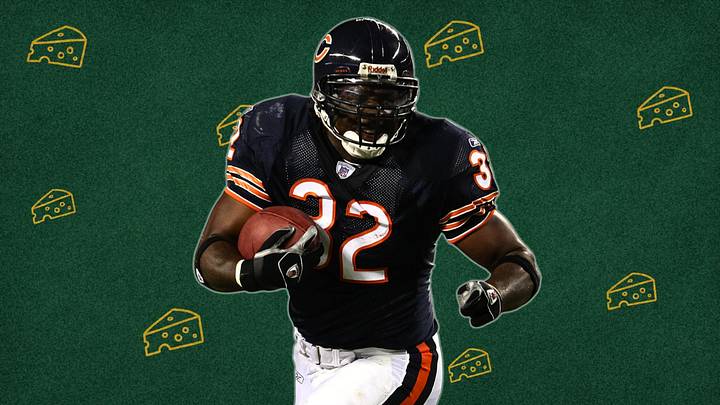
Sorry, Cheeseheads, but we've got another former Bears player here in running back Cedric Benson.
An All-Big 12 selection in each of his four years at the University of Texas, as well as a First-Team All-American and the Doak Walker Award winner in his final season with the Longhorns in 2004, Benson was taken by Chicago in the first round of the 2005 NFL Draft with the fourth overall selection.
The Bears were seemingly set to make the 5-foot-11, 225-pounder their lead back, but after he missed the entirety of training camp due to a contract dispute, he was ultimately relegated to the backup slot behind Thomas Jones, not only for his rookie campaign but for his second season as well. He spent just one more season in Chicago before being released in June 2008 after being arrested twice within a matter of weeks in alcohol-related incidents.
After being cleared in both cases, Benson signed with the Cincinnati Bengals, with whom he had four solid seasons, hitting the 1,000-yard mark in each of the final three and ultimately rushing for 4,176 yards and 21 touchdowns in 56 regular-season appearances.
Despite his success, he was allowed to waltz into free agency during the 2012 offseason and signed a one-year deal with Green Bay. He started the first five games of the season ahead of James Starks, rushing for 248 yards and a score on 71 carries and adding another 97 yards on 14 receptions, but in that fifth game, he suffered a Lisfranc injury to his left foot, which ended his season and ultimately his career, as he never took another snap.
Steve Bono, QB, 1997
We've got three quarterbacks on our list, and the first here in the third spot overall is Steve Bono.
A genuine journeyman at the professional level, the UCLA product started his NFL career with the Minnesota Vikings, who took him in the sixth round of the 1985 NFL Draft with the 142nd overall selection. He spent two seasons with the Vikes, completing two passes, and then spent another two seasons with the Pittsburgh Steelers, with whom he appeared in five games, starting three of them.
The Pennsylvania native then spent five seasons with the San Francisco 49ers, backing up both Joe Montana and Steve Young, before being traded in 1994 to the Kansas City Chiefs, where he again backed up Montana in his first year with the club.
In 1995, with Montana retired, he was given the QB1 role and certainly made the most of the opportunity, leading the Chiefs to a 13-3 record and earning his lone Pro Bowl selection after throwing for 3,121 yards and 21 touchdowns against 10 interceptions. He continued to start in 1996 but wasn't quite as successful, going 8-5 and tossing 12 TDs against 13 picks.
Kansas City opted to move on during the 1997 offseason, so Bono signed a one-year deal with the Packers to serve as Brett Favre's backup. With Favre never missing a game, Bono didn't get much of a chance to play, but he did end up appearing in two games in relief, completing five of 10 passes for 29 yards.
He closed out his career playing a season each with the St. Louis Rams and the Carolina Panthers.
Mark Brunell, QB, 1993-1994
Sticking with the quarterback position, we come to the player for whom we broke our one-season rule in Mark Brunell.
After an extremely interesting collegiate career at the University of Washington, where he was a Rose Bowl MVP before suffering a major knee injury that ultimately allowed Billy Joe Hobert to take his job, which he later got back after Hobert was suspended for violating NCAA rules, Brunell was taken by Green Bay in the fifth round of the 1993 NFL Draft with the 118th overall selection. With Hobert being taken in the third round at No. 58 overall by the Los Angeles Raiders, the duo became just the second pair of QBs from the same school to be taken in the same draft. So, that's fun.
With Favre set as the starter, Brunell competed with Ty Detmer for the backup role, and the two ended up alternating the QB2 and QB3 slots for two years. Brunell never saw the field during the regular season in 1993, but in 1994, he came on in relief in two games, completing 12 of 27 passes for 95 yards.
He became a restricted free agent during the 1995 offseason, and while the Philadelphia Eagles came to terms on a trade with the Packers to acquire him, the deal never came to fruition, as he refused to sign a long-term contract because he didn't want to back up Randall Cunningham. The deal that did go down, however, was one with the expansion Jacksonville Jaguars, who sent a third-rounder and a fifth-rounder to the Packers to acquire the lefty.
Brunell went on to spend nine seasons with the Jags, earning three Pro Bowl selections and throwing for 25,698 yards and 144 touchdowns, while also leading the team to a pair of appearances in the AFC Championship Game. He then spent four seasons with the team now known as the Washington Commanders, two seasons with the New Orleans Saints, and then two years with the New York Jets to close out his career.
Mark Clayton, WR, 1993
With the first of two wide receivers to make the list, we come to Mark Clayton.
A First-Team All-South Independent selection at Louisville in 1982, Clayton was taken in the eighth round of the 1983 NFL Draft with the 223rd overall selection by the Miami Dolphins. That '83 draft, of course, is best remembered for its class of quarterbacks, and with their first pick that year at No. 27 overall, the Dolphins selected Dan Marino.
Clayton didn't do much as a receiver as a rookie, spending more of his time as a return man, but in his second season, he became one of Marino's top targets in helping Miami reach the Super Bowl, and he and Mark Duper became one of the top receiving duos in the entire NFL.
In 10 seasons in South Beach, Clayton earned five trips to the Pro Bowl, also receiving a Second-Team All-Pro selection for his efforts in that '84 campaign, and ultimately tallied 550 receptions for 8,643 yards with 81 touchdowns, with the receptions and TDs still standing as franchise records and the yardage ranking second only to Duper (8,869).
He played the 11th and final season of his career in 1993 with the Packers, serving as the team's WR2 behind the great Sterling Sharpe. Clayton started 15 of Green Bay's 16 regular-season games, catching 32 passes for 331 yards and three touchdowns and adding a nine-yard grab in the postseason.
Terry Glenn, WR, 2002
Continuing with our second wide receiver, we come to Terry Glenn.
A First-Team All-Big Ten selection, a consensus All-American, and the Fred Biletnikoff Award winner at Ohio State in 1995, the 5-foot-11, 195-pounder was taken in the first round of the 1996 NFL Draft with the seventh overall selection by the New England Patriots.
Those same Patriots, of course, took on the Packers in Super Bowl 31 to close out the '96 season, and Glenn, who took second place in the Offensive Rookie of the Year voting, had a solid outing in the loss, catching four passes for 62 yards. Injuries plagued his next two seasons, but he had the best year of his career in 1999, making the Pro Bowl after making 69 catches for 1,147 yards and four touchdowns.
Glenn had another solid season in 2000, but some off-the-field issues hindered his 2001 campaign, as he appeared in just four games during the regular season. He caught only one touchdown in those four games, but it did just happen to be the first-ever TD pass thrown by Tom Brady. He was shut down toward the end of the year and did not appear for the Pats in their run to a Super Bowl title.
In March 2002, the Packers opted to take a chance on him, sending a pair of draft picks to New England to acquire his services. As the second option for Favre behind Donald Driver, Glenn tallied 56 receptions for 817 yards with two touchdowns in 15 regular-season appearances and added an 11-yard catch in Green Bay's playoff loss to the Atlanta Falcons.
During the 2003 offseason, the Packers traded Glenn to the Dallas Cowboys, with whom he spent the final five years of his career, catching 208 passes for 3,337 yards with 20 touchdowns.
Ted Hendricks, LB, 1974
Easily the most decorated player on this list is linebacker Ted Hendricks, who enjoyed a 15-year NFL career, won multiple titles, and earned all sorts of individual accolades.
A three-time All-American for the Miami Hurricanes, Hendricks was taken in the second round of the 1969 NFL/AFL Draft with the 33rd overall selection by the Baltimore Colts, with whom he spent the first five years of his career and won a Super Bowl while earning three trips to the Pro Bowl and a pair of All-Pro selections (one First Team, one Second Team).
Ahead of the 1974 season, the Guatamala native signed a futures contract to play with the Jacksonville Sharks of the upstart World Football League in 1975. Clearly wanting to get something instead of just letting him walk out the door a year later, the Colts traded him to the Packers a little over a month before the '74 regular season began.
And what a '74 campaign that turned out to be. While Green Bay as a whole wasn't great, going just 6-8, Hendricks was fantastic, earning a Pro Bowl selection, a First-Team All-Pro nod, and a third-place finish in the Defensive Player of the Year voting after tallying five interceptions, tying a career high, a ridiculous seven blocked kicks (three field goals, three PATs, one extra point), and a safety.
With the WFL set to go under, Hendricks obviously needed a place to play in 1975, but Green Bay was not that place, as the front office failed to meet his contract demands. He was still under club control from an official standpoint as what was then called a limited free agent, which meant the Packers could field trade offers, and Al Davis and the Oakland Raiders were so enamored with Hendricks that they sent Green Bay two first-round draft picks to acquire his services.
And it turned out to be a great move for the Silver & Black, as the 6-foot-7, 220-pounder went on to play nine years with the Raiders, helping the franchise win three Super Bowls while earning four more trips to the Pro Bowl and three additional All-Pro selections (two First Team, one Second Team). He retired following the 1983 season and was inducted into the Pro Football Hall of Fame in 1990.
Steve McMichael, DT, 1994
We promise that this is the last former Chicago Bears player you'll see on the list, but we obviously couldn't pass up Hall of Fame defensive tackle Steve McMichael.
It's sometimes easy to forget that McMichael didn't begin his career in the Windy City, as the Texas alum was taken in the third round of the 1980 NFL Draft with the 73rd overall pick by the New England Patriots, with whom he spent just one season before being released, at which point he signed with the Bears.
He spent his first few seasons in Chicago in a reserve role before finally cracking the starting lineup in 1983. And once he got the chance to play on a full-time basis, he certainly didn't waste it, as he became one of the best players at his position in the entire league. Despite his ferocious approach to the game, he also proved to be as durable as could be, as he set a franchise record with 191 consecutive games played.
McMichael received his first individual accolade during the Bears' magical 1985 Super Bowl-winning season, earning First-Team All-Pro honors. He then earned Second-Team honors in 1986 and First-Team honors again in 1987, also making the Pro Bowl in each of those two seasons. He earned one final Second-Team nod in 1991.
After the Bears terminated his contract ahead of the 1994 season, he opted to sign a one-year deal with the Packers and was actually named a defensive captain. He once again appeared in every game Green Bay played that year and tallied 28 total tackles and 2.5 sacks.
Jeff Saturday, C, 2012
For the lone offensive lineman on the list, we come to the great Jeff Saturday.
Despite being a two-time First-Team All-ACC selection at North Carolina, Saturday went unselected in the 1998 NFL Draft before signing as an undrafted free agent with the Baltimore Ravens, who cut him before training camp even got underway, at which point he took a job at an electric supply store.
The Indianapolis Colts signed the 6-foot-2, 295-pounder in 1999, and after starting a pair of games that year, he became the team's full-time starting center for Peyton Manning in 2000 and held the position for more than a decade, helping the team to a title (don't forget those Colts beat the Bears in the Super Bowl, Cheeseheads) and earning five trips to the Pro Bowl and three All-Pro selections (two First Team, one Second Team).
After 13 seasons with Indy, Saturday signed a two-year deal with Green Bay ahead of the 2012 season. While many didn't agree with the decision, given his up-and-down year for the Packers, a rollercoaster ride that actually saw him get benched late in the year, he was still named to the Pro Bowl for the sixth time. And despite being on the NFC squad, he was allowed to switch sides at one point during that game so that he and Manning could share one final snap, which was a pretty cool moment.
Saturday did not play that second year his original contract called for, as he retired following that Pro Bowl.
Jim Zorn, QB, 1985
We close things out back at the quarterback position with Jim Zorn, who split his collegiate career between Cerritos College, a juco in his home state of California, and Cal Poly Pomona.
After going unselected in the 1975 NFL Draft, he signed as an undrafted free agent with the Dallas Cowboys, only to be the last player cut ahead of the regular season. He then had a tryout with the Los Angeles Rams but failed to make that roster as well.
After a year away from football, Zorn signed with the expansion Seattle Seahawks in 1976 and ultimately became the team's first-ever starting quarterback, a role he kept for seven-plus seasons until he was benched in favor of Dave Krieg during the 1983 campaign. He remained with the team as Krieg's backup through 1984.
In 1985, Zorn signed with Green Bay to be the backup to Lynn Dickey. But with Dickey dealing with several injuries toward the end of his career, Zorn got five starts that season, going 3-2, and ultimately appeared in 13 games overall, completing 56 of 123 passes for 794 yards with four touchdowns against six interceptions.
He was released during the 1986 offseason, at which point he decided to spend a year in the CFL with the Winnipeg Blue Bombers. He returned to the NFL in 1987 with the Tampa Bay Buccaneers, winning his only start before retiring and embarking on a lengthy coaching career that spanned more than three decades.
 Add us as a preferred source on Google