

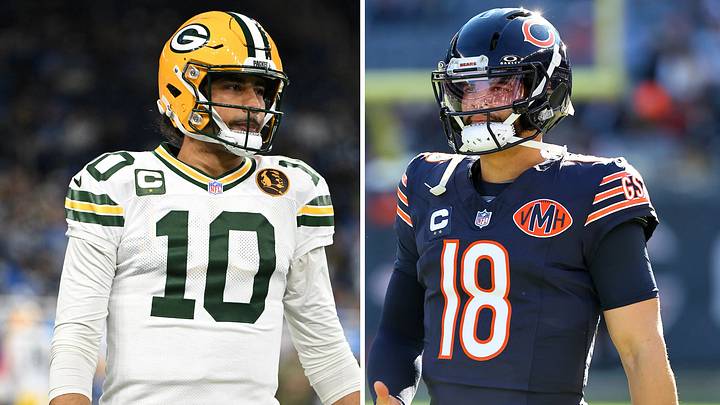
One is a rising star and a future MVP. The best quarterback in the NFC North. A quarterback who remains poised and ice-cool under pressure. A quarterback who made multiple highlight-reel throws to lead a stunning victory in their playoff debut. A quarterback who deserves to be on the Madden cover.
The other quarterback is Caleb Williams.
Williams is an ascending player and showed flashes of superstar potential last season, particularly in big moments. That's undeniable. But it's also unquestionable that Jordan Love is the better quarterback right now.
It's why I respectfully but emphatically disagree with FanSided's quarterback rankings ahead of the 2026 season. The 50 panelists rated every quarterback in the NFL on a 12-point scale. Love came in at No. 10, placing him in the "Strong QB1" tier with an average score of 9.32.
That's not the problem. The issue is that Williams is No. 9 with an average score of 9.38. It was agonizingly close, which feels painfully reminiscent of a certain playoff game we will no longer talk about.
The reality is that Williams does have superstar potential and has delivered MVP moments. He may eventually get there. But right now, before a snap has been taken in the 2026 season, Love is a tier above his division rival. And I'm here to prove it.
Six undeniable arguments that prove Jordan Love is way ahead of Caleb Williams
1. We can start with the absolute basics: Accuracy.
1a. Caleb Williams completed just 58.1 percent of his passes last season, which ranked 32nd among 33 qualifying quarterbacks. Only J.J. McCarthy had a worse completion percentage. Jordan Love completed 66.3 percent of his passes, ranking 15th.
1b. Bears fans will argue that we need extra context, that throwaways and dropped passes skew the numbers. Well, glad you brought it up, because PFF's adjusted completion percentage factors all of that in. It focuses only on "aimed passes thrown on target" and accounts for throwaways and drops.
Williams is still way behind there, with an adjusted completion percentage of 70.9 percent, which ranks 38th. Love's was 77.7 percent, ranking 8th. It's a significant gap.
1c. Pro Football Reference has an advanced stat called BadTh. It has a simple explanation: "Poor throws." Williams led the league with 109 bad throws and had a bad-throw percentage of 20.7 percent, ranking 3rd. Only Michael Penix and J.J. McCarthy had a higher percentage.
Love? Just 60 bad throws, ranking 20th, and a bad-throw percentage of 14.6 percent, which was the 11th-best record in the league.
2. While we're on the topic of advanced stats, let's pull out a few more.
2a. DVOA? Love ranked 3rd in the NFL, Williams 17th. EPA? Love 2nd, Williams 14th. EPA/play? Love 2nd, Williams 16th. PFF passing grade? Love 3rd, Williams 19th.
Per PFF, Love had a big-time throw percentage of 5.8 percent, ranking 6th. Williams' was 4.7 percent, ranking 16th. What about turnover-worthy plays? They were close, with Love getting the slight edge at 2.7 percent (12th) to Williams' 2.8 percent (15th).
In short, Love created explosive plays through the air at a higher rate without risking more turnovers.
3. Passer rating last season: Love 101.2 (6th), Williams 90.1 (22nd). QBR: Love 72.7 (3rd), Williams 58.2 (16th).
4. The next argument is that Williams is a clutch player who saves his best football for the crucial moments late in the fourth quarter. That's somewhat true. But that X-factor can hardly be used as a criticism against Love, because he shines under the brightest lights, too.
4a. Williams led the league with six fourth-quarter comebacks, and his six game-winning drives ranked No. 2.
Love wasn't far behind, though, with four fourth-quarter comebacks and four game-winning drives. He also missed effectively three games.
4b. Fourth-quarter comebacks aren't the be-all and end-all, anyway, because the best quarterbacks often have their team on top by the time the fourth quarter arrives. Williams had so many opportunities for miracle comebacks because his team regularly fell behind in the opening three quarters. Here are their stats last season from quarters 1-3:
- Love: 222/322 (68.9 percent), 2,632 yards, 17 TDs, 4 INTs, 106.0 rating
- Williams: 245/417 (58.8 percent), 2,800 yards, 17 TDs, 5 INTs, 87.6 rating
Love attempted almost 100 fewer passes but still posted the same number of touchdowns and only 168 fewer yards. He had a far better completion percentage, a better passer rating, and averaged 8.2 yards per attempt compared to Williams' 6.7.
4c. Besides, those fourth-quarter comebacks capture a few moments in time, not the whole story. There's a much better way to look at it. Let's analyze both players' full fourth-quarter stats when the game is within seven points. It's once again a win for Love. Here are the numbers, per ESPN:
- Love: 45/73 (61.6 percent), 558 yards, 6 TDs, 1 INT, 107.0 rating
- Williams: 40/72 (55.6 percent), 502 yards, 3 TDs, 2 INTs, 79.7 rating
Williams may have produced more magic moments that made it onto highlight reels, but that misses the full context. Last season, when a game was close (within seven points) in the fourth quarter, Love outperformed Williams.
4d. How about performances within the final two minutes of a half?
- Love: 32/57 (56.1 percent), 400 yards, 2 TDs, 0 INTs, 89.8 rating
- Williams: 50/103 (48.5 percent), 563 yards, 4 TDs, 1 INT, 74.2 rating
Neither quarterback completed a high percentage of throws here, but Love was far more efficient on almost half as many attempts.
5. One of Williams' strengths is his ability to avoid turnovers. Love is often slapped with the "gunslinger" tag, while many say he's careless with the football. But that's an outdated view. Love had one fewer pick than Williams last season. Granted, he also played almost three fewer games, which is a fair counterargument.
The reality is that both quarterbacks avoided turnovers at a high level, but as established earlier, Williams' ball protection came with fewer explosive plays.
5a. There's another myth we must address about Love. Many analysts believe he throws away games in crucial moments, including former NFL head coach Rex Ryan, who said this on ESPN's Get Up last October: "Statistically, it says he doesn't turn the ball over. Oh yes he does. The biggest moments, he'll turn it over."
We need some recent proof of that, Rex. How about the playoff game in January? It doesn't get much bigger than that. The Packers lost, but Love threw for 323 yards, four touchdowns, and no interceptions, earning a 103.8 passer rating.
In the same game, Williams threw for 361 yards, two touchdowns, and two interceptions, with a 71.6 passer rating.
A week later in the divisional round, Williams threw for 257 yards, two touchdowns, and three interceptions, with a 59.3 passer rating.
Love threw six interceptions in 16 games last season, including the playoffs. Williams threw five interceptions in two playoff games. Now, which QB is most likely to turn the ball over in big moments?!
6. We have to talk about the offensive line play. Williams has far more help in front of him than Love.
According to ESPN, last season, the Bears ranked No. 1 in the NFL for pass-block win rate and No. 5 for run-block win rate. Chicago's rushing attack finished No. 3. The team's PFF pass-block grade ranked No. 6, and the run-block grade finished No. 3.
Left guard Joe Thuney was a first-team All-Pro, Darnell Wright a second-team All-Pro. Thuney, Wright, and Drew Dalman went to the Pro Bowl.
Compare that to what Love had to deal with.
The Packers ranked No. 6 in ESPN's pass-block win rate metric but No. 19 in run-block win rate. Their rushing attack was far less of a factor, ranking No. 15 in total yards. PFF was harsher, with Green Bay's pass-blocking grade good for only No. 25 and its run-blocking grade down at No. 20.
Injuries decimated the offensive line. Per Sharp Football Analysis, the Packers' most-used starting five only played 17.62 percent of the snaps together, ranking No. 30 in the league.
Love did far more with less help. Williams may eventually become a better quarterback, but as things stand, Love is better in almost every department. Accuracy. Big-time throws. Adjustments at the line of scrimmage. Consistency. And the numbers back it up.
Pull out the stats, the advanced metrics, the splits, the PFF grades. Any of them. They all paint the same picture. And by the end of the season, we'll be pulling out the receipts – we're looking directly at you, FanSided QB rankings.
 Add us as a preferred source on Google