

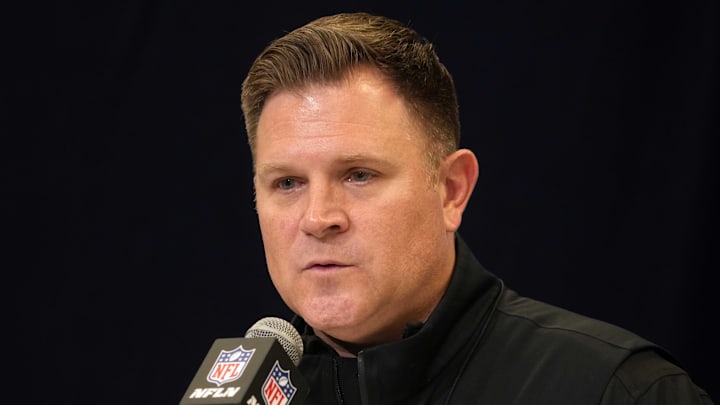
The Green Bay Packers took a different approach in free agency. Uncharacteristically, general manager Brian Gutekunst invested in a pair of older players, linebacker Zaire Franklin and defensive tackle Javon Hargrave, instead of going younger.
Acquired in a trade with the Indianapolis Colts, Franklin turns 30 in July. Hargrave, signed following his release from Minnesota, is 33. They have played 18 seasons between them.
In general, Gutekunst prefers to rely on internal development, the draft, and re-signing his own good young players. He did just that by bringing back Sean Rhyan on the offensive line, and implicitly by letting Romeo Doubs and Rasheed Walker leave in free agency. The Packers already have internal replacements lined up in Matthew Golden at receiver and Jordan Morgan at tackle.
Alongside those moves, however, the Franklin and Hargrave acquisitions stand out as outliers. Swinging on aging but productive veterans, a strategy that prioritizes immediate stability over long-term growth and potential, is Gutekunst's signal to the NFL world: the Packers are playing to win, and they want to win now.
Veteran free-agent additions fortify the Packers' young, organic core
That change in approach does not, of course, mean that Green Bay went out and signed the most expensive free agents available. They still have their compensatory picks to keep in mind, which they should anticipate from the Malik Willis, Romeo Doubs, and Quay Walker deals. The Packers could land four additional draft picks in 2027 as a result.
They should still get something for Rasheed Walker, though his one-year, $10 million deal with Carolina will result in a less favorable selection than the Packers had hoped. That was back when he was expected to command an annual salary of $20 million or more.
The Packers are still counting on Golden, Morgan, and right guard Anthony Belton to step up in 2026. Their faith in their own young talent hasn't changed.
What did change was Gutekunst's aggressive pursuit of older names. Even when the Packers splashed into the free-agent waters last year, their headline signings, cornerback Nate Hobbs and guard Aaron Banks, were both on the right side of 30. Banks was 27; Hobbs was 25.
Right now, with Hobbs released and Banks coming off a dismal, injury-riddled season of his own, both signings look like failures. This year, Gutekunst went in another direction.
Brian Gutekunst looked past age for sake of stability in known producers
Yes, Franklin is a buy-low addition, coming off a poorly-graded season in Indianapolis. He isn't, say, a Micah Parsons-sized declaration of Super Bowl aspirations.
Still, Gutekunst saw enough in him to sacrifice the younger, cheaper Colby Wolden in exchange. Even the Parsons trade, seismic as it was, fit the Packers' typical age constraints. In exchange for a 26-year-old All-Pro, they sent out Kenny Clark. Aside from being three years older, Clark also had more than double Parsons' mileage in games played.
Green Bay reversed roles in the Franklin-Wooden swap, and they continued in an anti-agist vein by signing Hargrave to a two-year, $23 million contract, including $13 million guaranteed.
By replacing Quay Walker with Franklin at linebacker and Wooden with Hargrave at defensive tackle, Gutekunst willingly added 12 years of seniority to the roster. Needless to say, that's not very Gutey-like.
There is, of course, one consideration that allowed the Packers GM to stay at least somewhat true to character. By acquiring Franklin via trade and Hargrave after his release, Gutekunst did nothing to harm Green Bay's comp. pick formula.
He did, on the other hand, add two former Pro Bowlers who raise both the Packers' floor and ceiling. Hargrave is an immediate upgrade on the defensive line. Plus, he has experience with new defensive coordinator Jonathan Gannon. If Franklin returns to anything near his monstrous 2024 form, he will be a significant upgrade over last year's version of Quay Walker.
After clocking in as the NFL's youngest roster in 2025, the Packers balanced out some of that youth by striking opportunistically to bring in some grizzled vets. Those moves may not be blockbusters, maybe they won't even work out, but they send the unmistakable message that the Packers are ready to test their present mettle in 2026.
 Add us as a preferred source on Google