

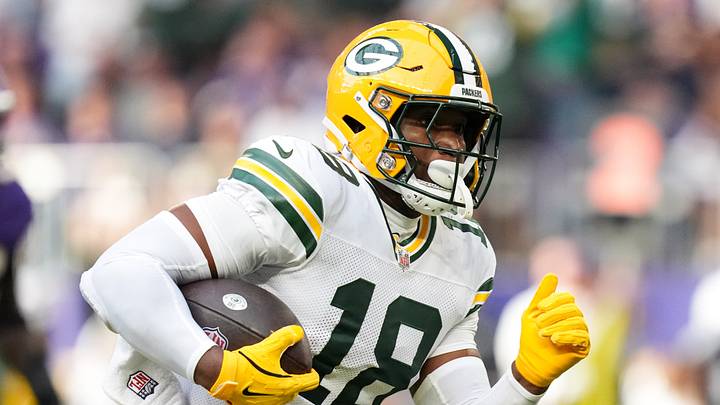
Now that the dust has settled on the monumental collapse of the Green Bay Packers' mind, body and spirit in Minnesota, it's time to start clearing the rubble and looking for some answers.
Week 1 games are unique in this aspect. It is much, much harder to figure out what is actually real. Did the Packers play a certain way because that's how they want to play over the course of the entire season, or was that due to a game plan catered more specifically to Minnesota?
After eight months of waiting to see what the 2026 Packers would finally look like, there were so many extenuating circumstances in this game that made it an especially challenging task.
First, the Packers are still trying to figure out what their 2026 identity is. The first game of the season is usually the worst-performed of the entire lot. It's important to remember that there were guys out there who were certainly not ready for the game from a physical standpoint.
Javon Hargrave, Green Bay's new addition on the interior line, hadn't played a single snap of preseason football before his debut on Sunday. One less preseason game, fewer practices over the offseason, and fewer reps in pads. There's just less time for players to get acclimated, all of which leads to players being less prepared for NFL football than they used to be.
Then, over the course of the game itself, a few things happened that also threw a wrench into the plans. First, the Vikings' quarterback situation started messy, then got weird. Kyler Murray isn't a QB that you can game plan against like a normal QB.
He's an outlier in some of the most extreme ways a quarterback can be, from his height (which changes the way Green Bay attacks the middle of the OL and what they do on the back end), to his shiftiness within the pocket, and his creativity outside of it. He's a guy you have to play differently. But then he gets hurt, and Minnesota shifts back to Carson Wentz as QB. How much of that game plan carried over between the two QBs?
But the ultimate outlier was what Brian Flores did to this offensive line. Minnesota blitzed on 73 percent of all passing downs, 47.2 percent higher than the league average. It's a rate that completely eclipsed anything else any team did last week. And understandably, that blitz rate created absolute havoc up and down the Packers' offense.
But I feel relatively comfortable stating that this was a trend that the Packers can look to tap into all season long: multi-TE formations.
Why we should expect to see more 2-TE sets from Packers' offense
In a short couple of days before the roster cutdown period, Green Bay signed veteran Jonnu Smith and traded for blocking tight end Mark Redman, two moves that clearly allowed the Packers to actually lean into heavier, multi-TE sets if they wanted to.
Still, I was of the opinion that the Packers would want the trio of Christian Watson, Matthew Golden, and Jayden Reed out on the field together as often as possible, their standard 11 personnel set. Remember that the first number represents RBs, the second represents TEs, and then the number of WRs is the remainder out of five. So, 11 personnel features one running back, one tight end, and three receivers.
Per Sumer Sports, Green Bay tapped into 11 personnel 47 percent of the time, which was eight percent lower than the NFL average in Week 1. The Packers ran 12 personnel 31 percent of the time for a mark of 9.5 percent above the league average, and 13 was used on 15 percent of all plays, six percent higher than the league average (and also would have been good for second in the entire league last season).
But the reason I'm confident that this is likely to be a season-long trend is because those percentages stayed consistent through the entire game. It wasn't necessarily a matter of keeping more blockers on the field once the pass rush started to get out of hand. There was less than one percent of difference between the amount of 11 and 13 played between the first and second halves of the game, and only a three percent difference in the amount of 12 played.
We saw a few times how the passing game benefited from this approach, with some big plays by Smith and Tucker Kraft throughout the course of the game. And if Green Bay does decide to lean into the TEs to help Love out, that's even more reason to keep it going.
This will be a trend to keep an eye on all throughout the year, as Green Bay looks to move on from its historic loss in Minnesota. Multi-TE formations are a growing trend league-wide (even the Los Angeles Rams, who pioneered this last season, played them at a much higher rate in Week 1). As Green Bay looks to notch its first win on the road against the New York Jets, this will be a big part of righting the ship.
 Add us as a preferred source on Google