

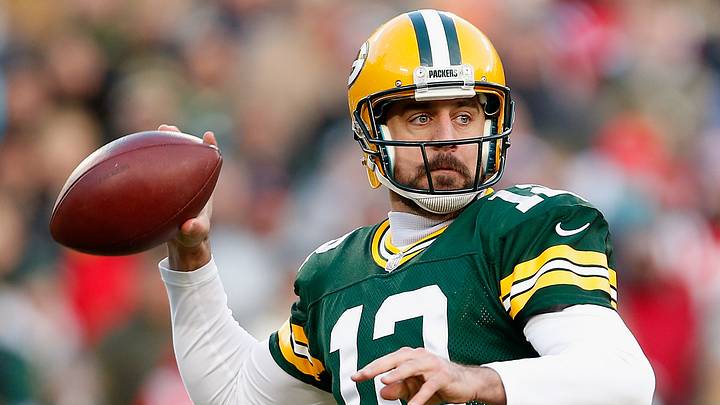
The Green Bay Packers have a storied history of drafting and developing players as well as anyone. Part necessity for being such a small-market team, and part impeccable culture defined by Vince Lombardi and countless other legends, there's a reason Green Bay is nicknamed Titletown.
Well, several reasons for that moniker really, but for purposes of this exercise, we're looking at the best 25 draft picks in Packers history. Trust that there's a wealth of talent to choose from.
Going in descending order here is certainly a choice. I run the risk of alienating the readership if the 20s pass and a preferred choice has yet to be named. Before you get too in your feelings, there's an honorable mentions section at the end after the No. 1 reveal. So do enjoy!
Also read our companion piece: The 25 worst draft picks in Green Bay Packers franchise history
25. Nick Collins, S, Bethune-Cookman (2005–2011)
A neck injury unfortunately cut Nick Collins' time in the NFL short. However, he still managed three Pro Bowl selections and was a pivotal piece of the defense that won Super Bowl XLV. From 2008 through 2010, Collins had 17 interceptions, and in the first season of that epic run, he scored three defensive touchdowns. Talk about a game-changer in the secondary.
Good on the Packers' front office for taking a swing in the second round at No. 51 overall on a prospect from Bethune-Cookman. Not exactly a hotbed teeming with NFL-caliber talent, am I right?
24. David Bakhtiari, OT, Colorado (2013–2023)
When you can find a decade-long franchise left tackle in the fourth round of the draft, you're doing something right. David Bakhtiari was a massive bright spot from a notoriously atrocious 2013 NFL Draft as the 109th overall pick in Round 4.
So many undeserving tackles went before Bakhtiari, including the Nos. 1 and 2 overall picks in Eric Fisher and Luke Joeckel. All Bakhtiari proceeded to do was earn All-Pro honors (two first-team, three second-team) every year from 2016 through 2020 before injuries caught up to him.
23. Greg Jennings, WR, Western Michigan (2006–2012)
If Ohio State is Wide Receiver U, Green Bay is, uh, the Ph.D. tenured professor center for wide receiver studies. Terrible analogy aside, Greg Jennings kicks off the all-time great Packers draft picks at this position of uncanny strength.
Jennings and Jordy Nelson are kind of intermingled as the key 1-2 punch who delivered the Packers their last Super Bowl win on that 2010 team with Collins. For Jennings, the 52nd pick out of Western Michigan, his run from 2007 through 2011 was most impressive, wherein he averaged 69 catches, over 1,100 yards and nine TDs.
22. Jordy Nelson, WR, Kansas State (2008–2017)

Two years after drafting Jennings, the Packers turned around in 2008 and found their next pass-catching stud in Jordy Nelson at No. 36 overall. He did not disappoint.
An exotic blend of size (6-foot-3), acceleration (1.50-second 10-yard split), and ball skills made Nelson a lethal downfield target for legendary quarterback Aaron Rodgers. Nelson had 57 TD grabs throughout a five-season run that spanned from 2011 through 2016. A torn ACL knocked him out for all of 2015, or he would've done even more damage toward the end of his heyday.
21. Jim Ringo, C, Syracuse (1953-1963)
Ah yes, here we begin the vintage picks with the seventh-round, 79th overall pick in Jim Ringo. He was about as dominant as one could fathom.
Snapping the ball to Bart Starr is no small-time gig. Ringo was a big-time player, earning All-Pro honors in his final seven seasons with the Packers, including six first-team selections. He was a cornerstone of Vince Lombardi's tenure and was instrumental in those 1961 and 1962 NFL championship teams.
20. Bob Skoronski, OT, Indiana (1956, 1959–1968)
Just a fair warning that this list will inevitably skew toward the more modern players, but that doesn't mean we should sleep on left tackle Bob Skoronski. The fifth-round pick (56th overall) in 1956 had to put his career on hold to serve in the U.S. Air Force, only to come back and continue being a dominant force in the trenches.
As a five-time NFL champion and two-time Super Bowl champ in the first two editions of the Big Game, Skoronski is woven into the fabric of pro football history as a prolific winner. He earned a Pro Bowl nod in 1966, and fun fact: his grandson Peter is an excellent guard for the Tennessee Titans nowadays.
19. Fred Carr, LB, UTEP (1968–1977)
No. 5 overall pick Fred Carr entered the NFL in a difficult spot. He was joining a Packers linebacker corps headlined by superstars in Ray Nitschke and Dave Robinson (more on both of them in a bit).
But Carr held up his end of the bargain and then some. Green Bay went through some dark years once Lombardi walked away, and Carr was his last first-round pick. At 6-foot-5 and 238 pounds with phenomenal speed, Carr was more or less the prototype for the modern linebacker. Oh, and he didn't miss a single game in his decade-long career.
Carr doesn't have the accolades of some on this list, but the three-time Pro Bowler was something of a revolutionary player who's easy to overlook in the annals of NFL history.
18. Donald Driver, WR, Alcorn State (1999–2012)

The leading receiver in franchise history. A seventh-round pick (No. 213) out of Alcorn State of all places. Yeah, Donald Driver is as legendary as it gets. He was the ultimate bridge between the Brett Favre and Aaron Rodgers eras.
As a key early mentor to Jennings and Nelson, Driver cemented the Packers' reputation as a wide receiver factory. Driver always played with a chip on his shoulder and as much competitive fire as any player to ever suit up for the green and gold. The four-time Pro Bowler joined the Packers Hall of Fame in 2017.
17. Antonio Freeman, WR, Virginia Tech (1995–2001, 2003)
Antonio Freeman averaged 68 receptions, 1,067 yards and over nine TDs at the peak of his powers from 1996 through 2001. In six playoff games when the Packers made back-to-back Super Bowl trips, he piled up 26 catches, 482 yards, and five touchdowns. Not a bad ROI for the 90th overall pick.
On Monday Night Football in 2000, Freeman made one of the greatest touchdown catches ever against the Vikings. In his two Super Bowl starts, he had an 81-yard TD to spur the Packers to victory and had nine catches, 126 yards, and two TDs in the heartbreaking 31-24 loss to John Elway's Denver Broncos.
Safe to say Freeman was often at his best on the biggest of stages. That's why he's worthy of being ranked so high.
16. Dave Robinson, LB, Penn State (1963–1972)
The forward pass wasn't as much of a thing back in Dave Robinson's prime. Shoot, the AFL-NFL merger didn't even happen till 1970. That didn't stop Robinson from hauling in a whopping 27 interceptions to go with 28.5 sacks.
Robinson was crucial to those Super Bowl I and II-winning Packers squads, and he was a three-time NFL champion, a three-time first-team All-Pro, and a three-time Pro Bowler. These things come in threes, you see? Had Robinson been drafted later than the 14th overall pick and perhaps played in a different era, he'd probably be higher on this list.
15. LeRoy Butler, S, Florida State (1990–2001)
As the pioneer of the Lambeau Leap celebration, LeRoy Butler (48th overall pick) deserves a special mention for that alone. The reason he was able to establish that iconic tradition in the first place, though, was because he was such a phenomenal player.
An absolute iron man with the physicality and ball-hawking prowess to match, Butler missed only three games in his first 11 seasons, all during the 1994 campaign. Otherwise, nothing was taking him off the gridiron. He was a first-team All-Pro four times.
Speaking of pioneers, Butler broke new ground as the first player of the *official stats era* to record 20+ sacks and 20+ interceptions. He wound up with 20.5 sacks and 38 INTs. You might've noticed that Dave Robinson hit those numbers back in the day when stats weren't considered "official."
14. Gale Gillingham, G, Minnesota (1966–1974, 1976)
It's a bold call nowadays to draft a guard with an early first-round pick. Gale Gillingham was too good of an athlete and prospect for Vince Lombardi to pass up with the 13th overall pick, even though the Packers had two strong guards in place from their NFL championship team in Jerry Kramer and Fuzzy Thurston.
By his second season, Gillingham had unseated the aging Thurston and proceeded to be a six-time All-Pro, a three-time NFL champion, and a key cog in the first two Super Bowl wins. I'd have Gillingham a little higher up, but positional value has to play a part here. Although in this case, it's quite impressive that Gillingham more than lived up to his draft status at arguably the least premium position.
13. Paul Hornung, RB/K, Notre Dame (1957–1966)

And we have arrived at the first NFL MVP on this list! Paul Hornung was the No. 1 overall pick in 1957, so the hype was stratospheric for "The Golden Boy." Hornung won MVP honors in 1961 while splitting time — this is 100 percent true — serving on active duty in the U.S. Army. That's about as legendary as it gets.
Although Hornung's legacy was tainted a bit by his season-long suspension for violating the league's gambling policy in 1963, his versatility was borderline unbelievable. In addition to putting up 5,191 scrimmage yards and 62 total rushing and receiving TDs in nine seasons, Hornung also made 66 field goals and completed 24 passes with five more TDs.
Hornung's kicking was very hit or miss (52 percent field goal success rate). However, in the 1961 NFL Championship Game, he drilled all three of his field goal attempts and four PATs in Green Bay's 37-0 shutout of the Giants. That was the first title during Lombardi's tenure.
12. Sterling Sharpe, WR, South Carolina (1988-1994)
Sterling Sharpe was the seventh overall pick in 1988 out of South Carolina. Although his career was limited to seven seasons due to a neck injury, Sharpe averaged 85 catches, 1,162 yards and over nine TDs per year. He retired after the 1994 season, just before Green Bay won Super Bowl XXXI over the New England Patriots.
Sharpe's abbreviated playing window didn't stop him from an induction into the Pro Football Hall of Fame in 2025. Well-deserved and overdue flowers in Canton, if you ask me.
11. Clay Matthews III, LB, USC (2009–2018)
Clay Matthews III had the pedigree to thrive in the NFL, but he was a former walk-on at USC who defied the odds to even be the 26th overall pick. Never mind what he did from there, as the chief defensive catalyst for that Super Bowl XLV team.
Matthews' position should've just been labeled "playmaker." He was as versatile as any front seven defender of my lifetime. He could drop in coverage with stunning efficacy for someone who routinely piled up double-digit sacks. His run of six Pro Bowls in seven years featured 12 forced fumbles, 36 passes defensed, six INTs (including two pick-sixes), 67.5 sacks, 372 combined tackles, and 97 tackles for loss.
10. Davante Adams, WR, Fresno State (2014–2021)

Quite a storied lineage of wide receivers for Davante Adams to follow. We've had five of them on this list of draft picks already, and Adams (Round 2, 53rd pick) carried plenty of high expectations with him.
After some problems with dropped passes early in his career, Adams roared back and became a legitimately elite wideout. Between his knack for finding the end zone, his outstanding chemistry with Aaron Rodgers, and some of the most precise route-running and footwork the sport has ever seen, Davante put up 669 receptions, 8,121 yards and 73 TDs as a Packer.
Adams' per-season averages from 2016 through 2021 were as follows: 97 receptions, 1,199 yards, 11.5 TDs. Now a member of the Rams and still chasing his first Lombardi Trophy, the 33-year-old vet has a shot to further his legacy beyond Green Bay.
9. James Lofton, WR, Stanford (1978–1986)
OK, so here's the deal with James Lofton. If you only have a 47.9 percent catch rate in your Packers career, yet you still average 1,073 yards, 59 catches, and18.2 yards per target, you might be pretty good at this whole football thing.
That's how you score this high on the list, even as the No. 6 overall pick. In fact, to this day, nobody has matched Lofton's 17.9 yards per touch.
Lofton found the end zone 49 times in Green Bay and still found loads of success once he left to play for the Raiders and Bills thereafter. The man was a one-of-one deep threat and went to seven of his eight Pro Bowls (when that still meant something) while he was in Titletown.
8. Jerry Kramer, G, Idaho (1958–1968)
Vince Lombardi was famous for his schematic innovation, the sweep run. That meant he needed excellent athletes at guard to lead the way for that perimeter blocking, and Jerry Kramer was the major catalyst who helped the Packers win five NFL championships and those first two Super Bowls during his career.
Kramer was the 39th overall pick (that was the fourth round back then, rather than the second) of the 1958 draft. He garnered All-Pro honors seven times, including five first-team bids. He was also a kicker for three seasons (1962-63 and 1968), making 29 of 54 field goal tries and 90 of 95 extra points.
Hard to overstate Kramer's importance to Green Bay's lore. For whatever reason, it took until 2018 for Kramer to be enshrined in the Pro Football Hall of Fame. One of the more egregious, longest snubs in the Hall's history.
7. Herb Adderley, CB, Michigan State (1961–1969)
When the Packers drafted Herb Adderley 12th overall in 1961, they envisioned playing him at running back and safety. Instead, he proved to be a phenomenal cornerback, and really, that ball-carrier vision helped him have a nose for the end zone as a lethal threat when he did take the ball away.
What I mean by that is, Adderley recorded a whopping seven pick-sixes among the 39 interceptions he made in Green Bay. Only 20 players have ever had that many INTs returned for touchdowns.
Adderley added four more interceptions in the playoffs for the Packers, plus another pick-six. He was sort of like Ed Reed before Ed Reed, except he played cornerback and not safety. Adderley won five NFL championships, was a seven-time All-Pro and won a third Super Bowl (VI) with the Dallas Cowboys once he left the Cheeseheads.
6. Jim Taylor, FB, LSU (1958–1966)

Although he was the 15th overall pick in 1958, Jim Taylor was a second-rounder because of how few teams there were at the time. In any event, fullbacks were a lot more valuable back in the day, serving more as a proper tailback.
Taylor was a proper workhorse in the backfield who, from 1960 through 1964, amassed 6,069 rushing yards and 66 TDs. That's a staggering amount of production. It led to a whole lot of winning (four NFL titles and a Super Bowl I triumph) and the 1962 MVP award.
Fun fact: 1962 was the only year of Jim Brown's career when he wasn't the NFL rushing champion. Taylor led the way with 1,474 yards (and 19 TDs!) while Brown finished fourth with 996 yards.
5. Ray Nitschke, LB, Illinois (1958–1972)
Sheesh, was that 1958 Packers draft class any good? We've already mentioned Jim Taylor and Jerry Kramer, but Ray Nitschke was part of that core, too, as the 36th overall pick in Round 3.
Nitschke enjoyed a 15-year career in Green Bay, which is obviously tremendous longevity at such a physical, grueling position. Although the official stats limit some of Nitschke's data points, he did record 25 interceptions, 23 fumble recoveries, and 16 sacks.
When you think of those hard-nosed, physical, hard-hitting defenses of the Vince Lombardi era, Ray Nitschke was at the epicenter of that whole phenomenon. One of the absolute greatest Packers of all time, draft pick or otherwise.
4. Forrest Gregg, OT, SMU (1956, 1958–1970)
Another massive part of the Packers' winning runs under Lombardi, Forrest Gregg was the 20th overall pick in the second round of the 1956 draft. After his rookie year, he had to take a season-long hiatus for military service before returning for a sensational Hall of Fame career.
Gregg played mostly right tackle, some right guard, and even left guard for the Packers. Wherever he lined up in the trenches, the seven-time first-team All-Pro was a force to be reckoned with.
Like Herb Adderley, Gregg left the Packers and won Super Bowl VI in Dallas, but he'd already won two Super Bowls and five NFL championships to help Green Bay earn its Titletown nickname. Hard to argue against Gregg as the best right tackle of all time in terms of individual greatness and the team-based accolades he had a huge hand in.
3. Jordan Love, QB, Utah State (2020–present)

Jordan Love is still writing his legacy, and it's been a bit of a roller coaster watching him so far. Nevertheless, Love is well on his way to being yet another top-flight quarterback in Packers history, continuing their tradition of surreal stability at the most important position on the field.
Green Bay deserves massive credit for taking Love 26th overall in the 2020 draft, too. Bobby Wagner notwithstanding, Utah State isn't some blue-blood program. Love was a raw prospect, and instead of helping his predecessor, Aaron Rodgers, with a weapon or another immediate-impact player in Round 1, the Pack ultimately drafted Rodgers' replacement.
That's a lot of pressure on the organization, and a lot of pressure on Love — especially since Rodgers won the next two league MVP awards. It all worked out in the end, though. Or at least it has so far.
After waiting his turn for three seasons behind Rodgers, Love has posted winning records and gotten the Packers to the playoffs in each of his first three years as a starter. He threw for 10,929 yards and 80 TDs to only 28 INTs in that span.
2. Bart Starr, QB, Alabama (1956–1971)
Similar to Vince Lombardi, Bart Starr is almost synonymous with the Packers franchise. Along with Johnny Unitas and Joe Namath, Starr is the first quarterback who springs to mind among those who most meaningfully shaped the modern NFL.
Starr had a very humble draft status (17th round, 200th overall pick), yet he lived up to his surname as the face of the Packers organization on the field. He laid the groundwork for a championship culture prior to Lombardi's arrival and was the MVP of the first two Super Bowls.
Among all of his accomplishments, Starr's playoff record is still stunning to look at to this day. He had a 9-1 postseason record with 15 TDs to only three INTs and a phenomenal 104.8 passer rating. Dude could sling it.
1. Aaron Rodgers, QB, California (2005–2022)

Pretty big slam dunk here. Aaron Rodgers would see Jordan Love drafted as his replacement in very similar fashion many years after he began his NFL career. When Rodgers was the 24th overall pick out of Cal, though, he was entering rather uncharted territory as the heir apparent to Brett Favre.
At least when the Love situation happened, Green Bay had lived through it once before. Favre was among the most beloved athletes of all time during his playing days, period. Rodgers was in the running to go No. 1 overall, only to see the 49ers pass him up in favor of Alex Smith. That led to an uncomfortable, agonizing wait in the green room, only for Rodgers to go be Favre's backup.
In spite of all that early turmoil, Rodgers became a four-time NFL MVP, a Super Bowl MVP, and one of the greatest players of all time. His blend of draft status, overall value, and pure greatness makes him the no-brainer choice as the greatest draft pick in Green Bay Packers history.
Honorable mentions
- 26. Edgar Bennett, RB, Florida State (1992–1996): Round 4, Pick 103
- 27. Robert Brooks, WR, South Carolina (1992–1998): Round 2, Pick 62
- 28. Mark Tauscher, OT, Wisconsin (2000–2010): Round 7, Pick 224
- 29. Tony Canadeo, RB/DB, Gonzaga (1941–1944, 1946–1952): Round 9, Pick 77
- 30. Chad Clifton, OT, Tennessee (2000–2011): Round 2, Pick 44
- 31. Josh Sitton, G, UCF (2008–2015): Round 4, Pick 135
 Add us as a preferred source on Google