

Two hundred and forty-five days, sixteen hours, and forty-nine minutes separated Caleb Williams' game-winner against the Green Bay Packers in January's wild-card round and Trey Smack's kickoff on Sunday at U.S. Bank Stadium.
That's a lot of time to reflect, to stew, to learn, to adapt.
The Packers did none of those things, falling into another fourth-quarter spiral that leaves them 0-1 and humiliated by Carson Wentz and the Minnesota Vikings.
This was supposed to be a new dawn. Yet as the Packers entered the fourth quarter up by five, "I Got You Babe" by Sonny & Cher started playing, and Groundhog Day returned.
Combine Sunday's loss to Minnesota with the playoff agony in Chicago, and Green Bay outscored its opponents 43-23 in the opening three quarters, only to lose the fourth quarter 6-47.
There's undoubtedly blame to be shared around, but most of the heat is on Matt LaFleur. I get it. LaFleur is the leader. He sets the tone and the identity, and it's fair to question why his conservative play-calling often resembles a head coach wilting under intense pressure.
I'd argue he's coaching with one arm tied behind his back. LaFleur wants to run the ball with a lead. He wants to drain clock, wear down opposing defenses, and follow the classic formula of winning teams. But LaFleur has an offensive line that simply can't do it. That falls squarely on the general manager.
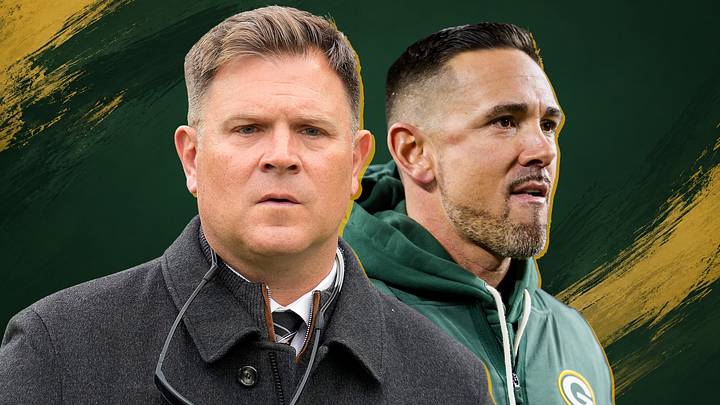
Brian Gutekunst is at blame, not Matt LaFleur, for Packers' latest collapse
Brian Gutekunst is an excellent roster-builder. Take nothing away from his body of work. His trades for Jordan Love and Micah Parsons are why the Packers are even discussed in Super Bowl conversations.
But Gutekunst must've known how concerning this offensive line was. We all knew.
Yet his offseason moves didn't reflect it. The Packers put faith in Jordan Morgan to replace Rasheed Walker at left tackle. Morgan couldn't break into the starting lineup at guard during his first two seasons, but Green Bay assumed those concerns would disappear by moving him to tackle, his college position. That was gamble number one.
Gutekunst's baffling decision to not only retain Aaron Banks, but also restructure his deal, was gamble number two. Banks has dealt with a knee injury all summer and missed Sunday's game.
Overpaying Sean Rhyan after ranking dead last among all centers in PFF pass-blocking grade last season? Gamble number three.
Not adding a top-tier interior lineman to compete with Anthony Belton or Jacob Monk at right guard? Gamble number four.
And that could be checkmate.
Packers' offensive line is again at the epicenter of the fourth-quarter meltdown
Sometimes a performance looks bad on the broadcast, but a deep dive into the numbers or a rewatch of the film tells a different story. Not this game. And it's a recurring pattern that goes back to the infamous January meltdown.
The Packers held a 21-3 halftime lead over Chicago in the playoffs. LaFleur understandably wanted to establish the run. The clock and the scoreboard were their big advantage.
But LaFleur couldn't count on his offensive line. In the second half, the Packers ran the ball eight times for just eight yards, and that included a six-yard effort from Josh Jacobs. The other seven attempts netted two yards.
It made Green Bay one-dimensional, toothless. Unable to wipe any time off the clock or sustain drives, which just played into Caleb Williams' hands.
The Packers' offensive line performance reached new lows on Sunday. Running the ball was just as challenging, with MarShawn Lloyd and Chris Brooks combining for 66 hard-fought yards on 20 carries at a pedestrian 3.3-yard average.
Then there was the abysmal, shambolic attempt to fend off the Vikings' pass rush. Brian Flores quickly learned that Green Bay had zero answers for the blitz, so he sent the house over and over and over again.
Per Next Gen Stats (via NFL Pro host Trevor Sikkema), four of the Packers' offensive linemen had a time-to-pressure average of 2.50 seconds or under.
"You can't function with those numbers. Part of a nightmare second half," Sikkema wrote.
Flores' blitz-heavy game plan left Green Bay's offensive line in ruins. Per Pro Football Focus, the Packers allowed 20 pressures and seven quarterback hits to go with four sacks.
Brian Gutekunst should've paid attention to what's happening in Chicago
It's a different story 211 miles south of Lambeau Field.
The Bears have quickly gone from the Packers' noisy little brother to the reigning, defending NFC North champions, Ben Johnson taunting them at any opportunity, and, now, the very real prospect of Caleb Williams leveling up into scary territory.
The engine to Chicago's success? The heartbeat of Johnson's ascending offense? His offensive line.
Johnson learned from Dan Campbell and Brad Holmes in Detroit. He knows that championship offenses live and die with the five players protecting the quarterback. It's why the Bears' first major act of the Johnson era was to completely rebuild the starting five.
Chicago traded for two Pro Bowlers, Joe Thuney and Jonah Jackson, for a future fourth-rounder and sixth-rounder, respectively. One day later, the Bears handed Pro Bowl center Drew Dalman $42 million.
It sounds painfully simple, but it paid off in a monumental way. The Bears' revamped starting five powered the league's No. 3-ranked rushing offense in 2025.
Turn on the tape from Chicago's terrifying 59-37 win over the Carolina Panthers in Week 1, and you'll see the offensive line bulldozing defenders. The Bears rushed for 291 yards and six touchdowns at 7.5 yards per carry – not a typo.
By contrast, you could hear the sound of a backup alarm anytime the Packers tried to protect Love, dazzled and dizzied by Flores' exotic pressures.
It's worrying.
You know when your team has an offensive line problem? When fans are yearning for Aaron Banks to return.
Help isn't on the way. Maybe Gutekunst signs a Kevin Zeitler or a Mekhi Becton, but any desperate move now is simply damage control. The Packers missed their opportunity to make meaningful upgrades.
And that's why this performance, and likely many more to follow this season, falls squarely on the general manager and not the head coach.
 Add us as a preferred source on Google