

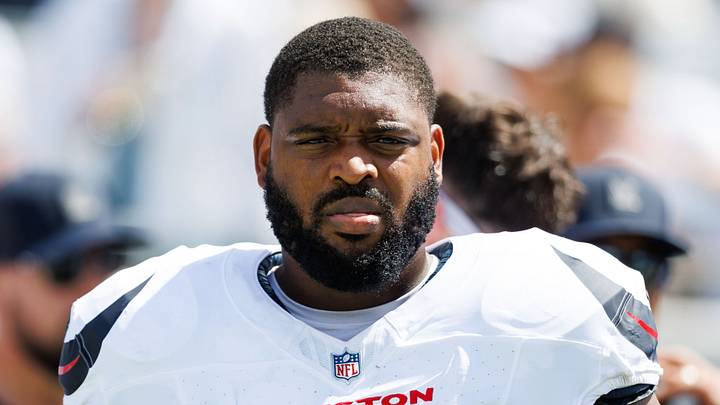
The Green Bay Packers had to change something on the offensive line, so they did. In Week 4 against the Tampa Bay Buccaneers, newly acquired veteran Laken Tomlinson started at left guard; Travis Glover replaced the injured Jacob Monk on the right side.
As a whole, the Packers surrendered no sacks and only seven pressures, after allowing 51 pressures in their first three games. Over half of those came against the Atlanta Falcons in Week 3.
While personnel changes no doubt influenced the improvements, the Buccaneers' puzzling strategy likely did, too. As beat writer Rob Demovsky pointed out, they blitzed only 17 percent of the time despite coming in with a blitz rate of 44 percent, fourth in the league.
Given Green Bay's prior struggles against the blitz - Vikings defensive coordinator Brian Flores probably still visits Jordan Love's nightmares - it seems prudent to take their performance with a grain of salt. Not that the Packers shouldn't be cautiously hopeful, but Tampa Bay head coach and defensive playcaller Todd Bowles certainly did them a favor.
Packers combined improved play with an easier task in Week 4
It doesn't make much sense, does it? Yes, Bowles' strategy worked, insofar as it held the Packers to 17 points. But after watching every defense annihilate them with pressure, including the Falcons just 10 days before, why not just keep throwing fastballs until the Packers proved capable of catching up?
For whatever reason, the Buccaneers had other ideas, and Green Bay's offensive line should thank them. Another stat from Demovsky: the Packers posted a 53 percent pass-block win rate versus 16 percent across Weeks 1-3. Amazing.
Some of that is real. It has to be. Subtracting Monk, Donovan Jennings, and Jager Burton from the guard rotation made an apparently exponential difference.
And perhaps Bowles was content with the trade-off, keeping more defenders back in coverage to limit big gains. The Packers had one completion of 20-plus yards, a 25-yarder to tight end Mark Redman. Their wideouts combined for seven catches for 66 yards.
Love averaged a tick under nine yards per completion. He posted season lows in average depth of target (7.4 yards) and average air yards per catch (2.8), according to Next Gen Stats. Yards after the catch accounted for over two-thirds of the Packers' total passing production.
Despite the lack of pressure, Love averaged 2.43 seconds to throw, less time than last week and in every game this season except Week 2 against the Jets.
In other words, the Packers took what the defense gave them, did a lot of dink-and-dunking, and didn't task the offensive front with maintaining extended pass protection. Combined with Tampa Bay's uncharacteristic anti-blitz strategy, the offensive line had arguably its easiest assignment of the year.
That's not to rain on the Packers' just-maybe-this-can-work parade. Kevin Zeiter is still getting into game shape and should be an upgrade over Glover at right guard whenever he suits up, possibly as soon as this week. In any case, it can only go up from here.
At the same time, despite undeniable progress, it's a good idea to remain a little wary of last game's sudden improvements given the surrounding context. Other teams might not take pity on the Packers as Bowles did.
 Add us as a preferred source on Google