

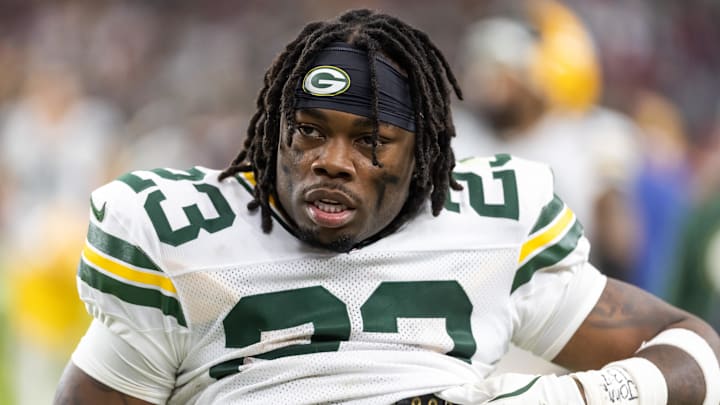
The Green Bay Packers have made it clear they want Josh Jacobs back next season, but there is uncertainty behind their Pro Bowler on the depth chart.
Emanuel Wilson's future with the Packers is now up in the air. According to ESPN's Jeremy Fowler, Green Bay has decided not to place a restricted free-agent tender on Wilson, which means he will now become an unrestricted free agent at the beginning of the new league year on March 11.
It's a somewhat surprising move, as Wilson has become a reliable No. 2 behind Jacobs while also proving he could lead the backfield if Jacobs misses time. Using the right of first refusal tender would've cost the Packers only $3.8 million in 2026, and their decision to decline it is a risky one.
Packers are rolling the dice at running back by not using RFA tender on Emanuel Wilson
Before we break down what this means for the Packers, let's first explain the choices the team had.
Wilson was a restricted free agent, which gave the team more control. There are three tenders available: a first-round tender, a second-round tender, and a right of first refusal tender.
Had the Packers used any of the three, it wouldn't have prevented Wilson from negotiating with other teams, but Green Bay would've had a say. Had he agreed to terms on an offer sheet with a different team, the Packers would've had the opportunity to match that offer to keep him in Green Bay. Wilson would only have signed with the other team had the Packers refused to match the offer sheet.
READ MORE: Obvious Malik Willis replacement may have just landed in the Packers' laps
With a first-round tender, the Packers would've received a first-round pick as compensation if he joined another team. But that tender is the most expensive, as it would've cost Green Bay $8.74 million. The second-round tender is more affordable at $6.26 million, which, of course, comes with the safety net of a second-round pick. The right of first refusal tender is the cheapest, but it also means there's no compensation if the player joins another team.
In 2018, the Packers signed Chicago Bears cornerback Kyle Fuller to an offer sheet. He wasn't a restricted free agent, but the Bears had used the transition tag on him, creating a similar scenario. Chicago opted to match Green Bay's deal with Fuller, which meant the Bears retained him.
Back to Wilson.
Green Bay declined to use a tender at all. The team could still re-sign him to a multi-year extension, which could be a way of reducing his 2026 cap hit. However, that's only if Wilson agrees. He may prefer to test the market as an unrestricted free agent, and there's bound to be interest around the NFL.
Wilson proved himself this past season, rushing for 496 yards and three touchdowns at four yards per carry. He stepped into a starting role due to Jacobs' injury in Week 12 against the Minnesota Vikings, turning 28 carries into 107 yards and two touchdowns.
By declining the option to use an RFA tender, the Packers will now have to compete with other teams to make a deal with Wilson.
If he leaves in free agency, it won't gain the Packers a 2027 compensatory pick. They'd lose him for nothing. More concerning is how it would impact the running back depth chart.
Jacobs remains the featured back, but Green Bay needs to give him plenty of support. He battled injuries throughout the 2025 season, which made Wilson such a valuable backup. Without Wilson, the Packers would only have Jacobs, MarShawn Lloyd, Pierre Strong Jr., and Damien Martinez under contract (Strong and Martinez signed futures deals). Chris Brooks is also a restricted free agent.
Running back may increase from a quiet, under-the-radar need into a far more urgent one.
Green Bay can't afford to enter 2026 with Lloyd and Brooks (if he re-signs) backing up Jacobs. Lloyd has played only one game in two seasons due to injury, while Brooks has just 63 carries in two seasons for the Packers.
And without a first-round draft choice, the Packers may need to use their selections on more pressing needs along the offensive and defensive lines, as well as cornerback.
They could still re-sign Wilson to a long-term deal, but if he leaves in free agency, running back will suddenly become a concern.
 Add us as a preferred source on Google