

The Green Bay Packers have spoiled us with offensive line play over the years, but those days are gone. None of David Bakhtiari, Bryan Bulaga, Josh Sitton, T.J. Lang, or Corey Linsley are coming back to save them now.
After three weeks of, let's just be blunt here, embarrassing play from the Packers' offensive line, it's fair to say they've well and truly hit rock bottom.
Just how bad is it? According to PFF's Daire Carragher, Jordan Love has been hit or sacked 27 times in the opening three games, the highest number any quarterback has faced in 17 years.
It didn't happen overnight, though. The Packers' protection has been in steady decline for several years, and a series of poor decisions has only accelerated the descent. It's a problem Packers fans saw coming all summer. For years, in fact.
So, how did we get here?
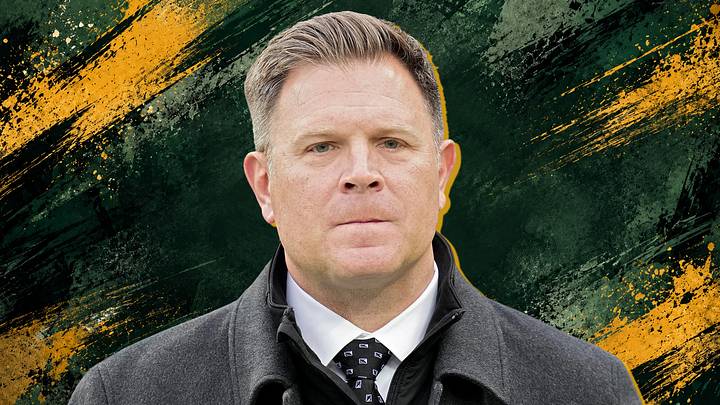
Brian Gutekunst has built an excellent resume in Green Bay. His rosters compete year in, year out, with the Packers failing to make the playoffs only twice in eight seasons under his leadership. Gutekunst brought us Jordan Love and Micah Parsons.
But he's also primarily responsible for the offensive line nightmare that already threatens to ruin their season. It's been a slow process over the past six years. Let's break it down.
Breaking down the Packers' notable offensive line moves that led to the dramatic decline
2021: The first major mistake
- Drafted Josh Myers over Creed Humphrey
One of Gutekunst's first major tasks on the offensive line was replacing All-Pro center Corey Linsley, who departed for the Los Angeles Chargers in 2021. Linsley had started 99 games in Green Bay and left a major void at center.
Gutekunst understood the urgency and selected Ohio State's Josh Myers in the second round. Notably, the Kansas City Chiefs selected Oklahoma's Creed Humphrey one selection later.
The Myers pick was hardly a disaster. He started 56 games for the Packers and was a solid but inconsistent center during that time. Passing on Humphrey, though, was a major miss. He has become a four-time Pro Bowler and three-time All-Pro in Kansas City. You won't find a better center in all of football.
And it's not Monday Morning Quarterbacking here, because Humphrey felt like the better Packers fit at the time. He had the athleticism they love, the pass-blocking traits, and the proven college production, having allowed zero sacks in three seasons for the Sooners.
If the Gutekunst had drafted Humphrey, there's a strong chance he'd still be starting at center in Green Bay today.
2022: A strong draft, but not a sign of what's to come
- Drafted Sean Rhyan, Zach Bako-Bewele, Rasheed Walker
- Traded Cole Van Lanen
It's hard to have too many arguments with this draft class. Unfortunately, though, it has proven to be the exception over this six-year period.
Zach Bako-Bewele was undeniably a steal in Round 4. That's the kind of move Ted Thompson made repeatedly in the draft. Bako-Bewele proved he could play at multiple positions before becoming a Pro Bowl-caliber right tackle. Unfortunately, he will miss the remainder of the season after suffering a torn patellar tendon.
Sean Rhyan has become a starter for the Packers, but it's hard to call it a home-run pick. Rhyan barely saw the field in his first two seasons and ended up getting benched at guard before finding a home at center.
Gutekunst deserves praise for the Rasheed Walker pick. To get 48 solid starts from a seventh-round selection is excellent work.
The Packers quietly made a mistake in the summer, though, trading Cole Van Lanen to the Jacksonville Jaguars for a seventh-round pick. Van Lanen was born and raised in Green Bay, Wisconsin, but his hometown team gave up on him far too soon.
Van Lanen has gone from a capable backup to a starter in Jacksonville. He can play multiple positions along the line but has found a home as the Jaguars' starting right tackle.
2023: A mistake still haunting the Packers today
- Didn't draft an offensive lineman
The Packers had 13 draft picks in 2023. Yes, thirteen. Gutekunst didn't use any of them to strengthen the offensive line. That's a no-no in Green Bay, with a philosophy dating back to Ron Wolf. The Packers have selected at least one lineman in 33 of their past 36 drafts. The 2023 class was one of the few exceptions.
Gutekunst burned picks on a backup quarterback and kicker but found no room to add competition along the offensive line.
Who knows whether any additions would've stuck around long-term – the draft is a lottery, after all – but that's why you need to take swings every year. Any linemen selected in 2023 would now be entering their fourth season.
That sure could've helped this year's team.
2024: A pivotal offseason
- Released David Bakhtiari
- Drafted Jordan Morgan, Jacob Monk, and Travis Glover
- Signed Andre Dillard
- Moved on from Yosh Nijman
This was a big offseason for the Packers, which began on the first day of free agency with the release of David Bakhtiari. It was a tough but inevitable decision. Green Bay needed to clear cap space, and Bakhtiari hasn't played since.
Gutekunst got that decision right, but almost none of the moves that followed.
The Packers selected Jordan Morgan in the first round but had no clear plan for him. Gutekunst stood at the podium and predicted Morgan would play four positions for the Packers. At this point, I'm not sure he can even play one.
Many draft analysts believed Morgan would have to move inside at the NFL level, which he did. But the Packers' experiment at guard quickly failed, with Morgan unable to break into the starting lineup. He's the new starting left tackle this year, but he's already allowed two sacks in three games, per PFF.
Jacob Monk is currently starting at right guard, but he has a woeful PFF pass-blocking grade of 41.9, having allowed a team-high 11 pressures and a sack.
2025: Brian Gutekunst continues to swing and miss badly
- Signed Aaron Banks
- Drafted Anthony Belton and John Williams
- Traded for Darian Kinnard
Gutekunst recognized the need to improve the offensive line in 2025, so he threw money and premium draft capital at the problem. As we sit here in Week 3 of the 2026 season, it sure looks like the Packers wasted it all.
Aaron Banks has been in and out of the lineup with injuries ever since he arrived in Green Bay. He's played just 22 snaps this season. And it hasn't gone well when he's available – last season, Banks' 53.5 PFF grade ranked 65th among 81 guards, not exactly what Gutekunst had in mind after handing him the NFL's ninth-highest salary at the position.
It hasn't gone much better for Anthony Belton, a second-round pick a year ago. Belton stepped in at right guard out of necessity last season but lost that job to Jacob Monk this summer. He's now back at right tackle as Bako-Bewele's replacement, but has allowed eight pressures and three hits on just 94 pass-block snaps, per PFF.
2026: Today
- Moved on from Rasheed Walker and Elgton Jenkins
- Extended Sean Rhyan
- Restructured Aaron Banks
- Drafted Jager Burton
The Packers won't have lost much sleep from the Rasheed Walker and Elgton Jenkins departures. Walker was coming off a rough season, while Jenkins' contract was simply too high to justify.
It's hard to defend Gutekunst's work beyond that.
Green Bay's offensive line needed reinforcements. Significant work. Gutekunst admitted that the line needed to play better when speaking to reporters in February.
"It was a lot of moving parts and we never got off the way we wanted to," Gutekunst said. "We had some young players playing, some guys that had moved positions, some injuries happened and guys were moving around, some players in contract years, so there were a lot of things going on there."
He said a whole lot of nothing. Gutekunst's actions spoke louder than any words, as he effectively decided to run it back. Sure, Walker and Jenkins departed, but Gutekunst believed Jordan Morgan and Sean Rhyan could fill those spots.
The Packers made Rhyan one of the highest-paid centers in football, a bizarre decision, and then restructured Banks' contract, an inexcusable move. It makes Banks almost impossible to cut before 2028.
Gutekunst made one addition along the line by drafting Jager Burton in the fifth round. Burton's debut couldn't have gone much worse against Atlanta, but it's far too soon to judge him. Burton is a fifth-round rookie and needs time, and he impressed throughout the summer.
But there's the problem. The fact Green Bay even needed to throw a fifth-round pick out there so soon says it all.
Gutekunst's work this past offseason is hard to defend. He watched his offensive line fail to run-block all last season, and his solution was to run it back and only add a fifth-rounder.
Gutekunst has made some good calls along the offensive line over the past half-decade, but way more bad ones. Add in the departures of Bakhtiari and Linsley, and it's no wonder Green Bay's offensive line has slowly gone from one of the league's best to undeniably the worst.
 Add us as a preferred source on Google